
Antibody profiling for precision dermatology
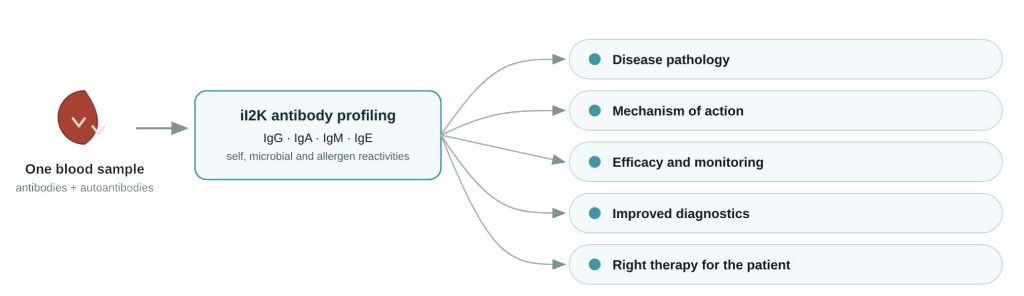
A single blood sample, interrogated for the full antibody and autoantibody repertoire, to resolve disease endotypes, illuminate mechanism of action, quantify pharmacodynamic response, and guide rational therapy selection.
The clinical rationale
- Dermatological disease is etiologically heterogeneous, spanning adaptive autoimmunity, barrier dysfunction with allergen sensitization, and dysbiosis-driven inflammation, frequently co-occurring in one patient. A shared diagnosis rarely implies a shared mechanism.
- Multiplexed serology resolves this heterogeneity from a single blood draw, quantifying autoreactivity to self antigens together with humoral responses to microbial and allergenic exposures.
- The translational payoff is concrete: molecular diagnosis and endotyping, mechanistic insight, pharmacodynamic monitoring, and a rational basis for therapy selection. [4]
| DISEASE AXIS | PRIMARY DRIVER | ROLE OF MICROBIOME / ALLERGENS | EXAMPLES |
|---|---|---|---|
| Autoimmune / autoinflammatory | Adaptive immunity targets self-antigens | Secondary: may precipitate flares | Cutaneous lupus (CLE), systemic sclerosis (diffuse cutaneous), vitiligo, pemphigus, alopecia areata, autoimmune (type IIb) CSU |
| Barrier-driven / atopic | Barrier defect enables allergen and microbial ingress | Major: dysbiosis and pathogen overgrowth sustain inflammation | Atopic dermatitis, contact dermatitis |
| Systemic mixed-axis | Internally driven hyper-immune response, gut-skin axis | Modulatory: gut dysbiosis aggravates cutaneous disease | Psoriasis, hidradenitis suppurativa, CSU |
Autoreactivity is a recurring thread
- Autoreactivity recurs across the dermatological spectrum: pan-disease markers such as antinuclear antibodies (ANA) and anti-thyroid-peroxidase (anti-TPO) are prevalent, whereas disease-restricted specificities remain incompletely mapped, as in hidradenitis suppurativa.
- The iI2K content already encompasses established diagnostic autoantigens. In idiopathic inflammatory myopathy, myositis-specific autoantigens have been mechanistically linked to TLR7/8-dependent type I interferon induction, exemplifying how a reactivity signature reports on pathogenesis rather than mere association. This Alden-led study was selected for the journal’s Clinical Connections clinical highlight. [1,6]
- Interpreting the composite signature, rather than a single analyte, identifies the patients whose disease is driven through a defined pathway, those most likely to benefit from a mechanism-matched therapeutic.
Effector function is isotype-determined
The same epitope engaged by different heavy-chain classes elicits distinct biology, and the classes span several orders of magnitude in serum abundance.
| ISOTYPE | HEAVY CHAIN | SERUM CONCENTRATION | SHARE | HALF-LIFE | MAIN FUNCTION |
|---|---|---|---|---|---|
| IgG | γ | ~10 mg/mL | ~80% | 23 d | Dominant systemic antibody; neutralization, opsonization, complement fixation; immune memory |
| IgA | α | ~2 to 3 mg/mL | ~13% | 5.8 d | Mucosal immunity; mucus, saliva, tears |
| IgM | μ | ~1.5 mg/mL | ~6% | 5.1 d | Early response; pentameric complement fixation; B-cell receptor |
| IgE | ε | ~50 to 300 ng/mL | <0.001% | 1.3 d | Allergy and anti-parasite; arms mast cells and basophils via FcεRI |
CSU: two resolvable autoimmune endotypes
- CSU resolves into type I (autoallergic), mediated by IgE autoantibodies to autoallergens that cross-link FcεRI, and type IIb (autoimmune), mediated by IgG autoantibodies to FcεRI or receptor-bound IgE, with divergent serology, disease course, and therapeutic responsiveness. [5]
- Endotype discrimination is contingent on reliable IgE autoantibody detection. Given the four-to five-log excess of IgG over IgE, Alden employs a dedicated IgE-enrichment step that renders type I profiling analytically tractable where conventional assays fail. [3]
- In the Novartis remibrutinib (REMIX-1/2) program, a composite IgE and IgG autoantibody panel discriminated CSU from healthy controls with high sensitivity and specificity and supports endotype-level stratification in trials. [2]
The strategic payoff: one array, every program, one compounding database
Why this compounds across a development portfolio
- A single standardized iI2K array is deployed across autoimmune, oncology, allergy, and infectious-disease programs. A new dermatology study therefore inherits a validated, cross-indication method rather than a bespoke assay.
- Each program accrues to a harmonized, cross-disease and cross-subgroup compendium of antibody reactivities. Shared antigen content and shared control cohorts mean every subsequent study begins from established benchmarks.
- This is Alden’s differentiator: not an isolated assay but a comparable, compounding readout that converts one blood sample into diagnosis, mechanism, pharmacodynamics, and therapy selection across an entire portfolio.
References
- Wu Y, et al. TLR7/8 activation by RNA-containing immune complexes in myositis. Arthritis & Rheumatology. 2025;77(2):190-201.
- Saini S, Metz M, Hide M, … Budde P, Bräutigam M, Zucht HD, et al. A novel panel of autoantibodies may assist in the molecular diagnosis of CSU. J Allergy Clin Immunol. 2026;157(2 Suppl):AB8 (AAAAI 2026, Abstract 022). https://www.jacionline.org/article/S0091-6749(25)01211-4/fulltext
- Karachaliou C-E, Livaniou E. Immunochemical determination of IgE and IgG autoantibodies in patients with chronic spontaneous urticaria: a narrative review. Antibodies. 2026;15(2):44. doi:10.3390/antib15030044.
- Biomarkers and treatment selection in dermatology: Dermatology Times (EADV plenary); ReproCell/Biopta.
- Maurer M, Eyerich K, Eyerich S, et al. Urticaria: Collegium Internationale Allergologicum (CIA) Update 2020. Int Arch Allergy Immunol. 2020;181(5):321-333. doi:10.1159/000507218.
- Clinical Connections. Arthritis & Rheumatology. 2025;77 (highlight of ref [1]). doi:10.1002/art.42874.
Figures are original Alden Scientific Immune artwork.
Explore all applications and disease areas :
- What are Autoantibodies (antibodies)?
- ImmunoINSIGHTS™ Platform
- Autoimmune Diseases
- Immuno-oncology
- Infectious Diseases
- Neurological Diseases
- Multiplex Serology